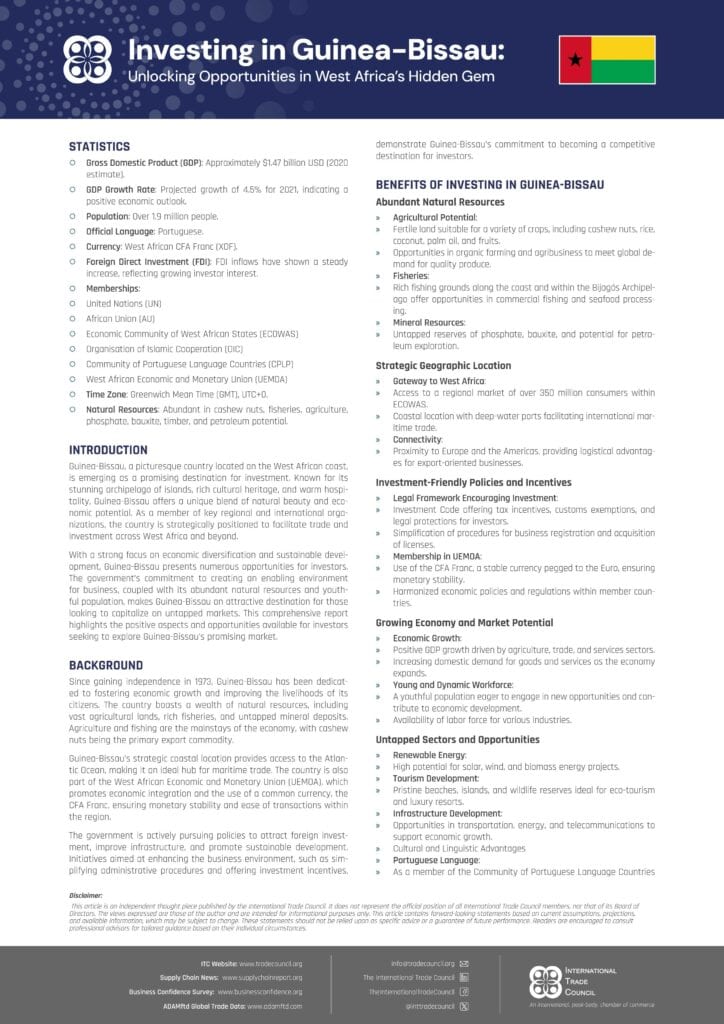
Doing Business with Guinea-Bissau

A comprehensive guide to doing business, exporting, investing, and manufacturing in Guinea-Bissau.

Foreign Direct Investment with the International Trade Council / Company Incorporation / Company Formation

Guinea Bissau National Investments Agency

National Chamber of Commerce

Câmara de Comércio, Indústria, Agricultura e Serviços da Guiné-Bissau

CCIAS Guinea-Bissau logo: Industry, agriculture, commerce, and services. - International Trade

Tel: +245 956 601 673

Email: [email protected]

Ministry of Economy Information from the International Trade Council - a Peak-body - international chamber of commerce

Ministério das Finanças, Guiné-Bissau


  • Type of Government: Semi-presidential republic
  •      

  • Population: Approximately 2 million
  •      

  • GDP: Around $1.5 billion USD
  •      

  • Corporate Tax Rate: 25%
  •      

  • Personal Income Tax Rate: 0% to 20%
  •      

  • Major Exports: Cashew nuts, fish, seafood
  •      

  • Major Imports: Foodstuffs, machinery, fuel


Exporting to Guinea-Bissau involves several steps. Here’s a comprehensive guide:


  1. Research Market Requirements


    • Understand Guinea-Bissau’s import regulations and standards for your product.
    •      

    • Check for any product-specific certifications needed.
  2.      

  3. Identify Local Partners


    • Establish relationships with local distributors or agents in Guinea-Bissau.
  4.      

  5. Prepare Export Documentation


    • Include commercial invoices, packing lists, and certificates of origin.
    •      

    • Ensure compliance with labeling and packaging requirements.
  6.      

  7. Arrange Logistics and Shipping


    • Choose a reliable shipping company experienced with exports to Africa.
    •      

    • Ensure accurate completion of shipping documents, such as bills of lading.
  8.      

  9. Customs Declaration


    • Work with a customs broker to facilitate the clearance process.
    •      

    • Pay any necessary duties and taxes.
  10.      

  11. Understand Duties and Taxes


    • Familiarize yourself with Guinea-Bissau’s import duties and applicable taxes.
  12.      

  13. Distribution and Sales


    • Establish distribution channels within Guinea-Bissau.
    •      

    • Consider partnerships with local businesses for effective market penetration.

Key Contacts

Importing goods into Guinea-Bissau involves several key steps. Here’s a detailed guide:


  1. Verify Import Regulations


    • Ensure your goods comply with Guinea-Bissau’s import regulations.
    •      

    • Check if your products require special permits or certifications.
  2.      

  3. Classify Your Goods


    • Determine the correct tariff classification using the Harmonized System (HS) codes.
  4.      

  5. Obtain Necessary Licenses


    • Apply for any required import licenses or permits for specific goods.
  6.      

  7. Prepare Import Documentation


    • Necessary documents include commercial invoices, packing lists, and certificates of origin.
  8.      

  9. Arrange Shipping and Logistics


    • Choose a reliable logistics provider experienced with imports to Guinea-Bissau.
    •      

    • Ensure proper packaging and labeling of goods.
  10.      

  11. Customs Declaration


    • Submit a customs declaration to Guinean-Bissau customs authorities.
    •      

    • Pay any applicable duties and taxes.
  12.      

  13. Customs Clearance


    • Work with a customs broker to facilitate clearance if needed.
    •      

    • Ensure compliance with all import requirements.
  14.      

  15. Receive Goods


    • Coordinate with your logistics provider to receive and inspect goods upon arrival.

Key Contacts

Incorporating a company in Guinea-Bissau involves several steps. Here’s a comprehensive guide:


  1. Choose a Company Structure


    • Decide on the type of company (e.g., Limited Liability Company, Corporation).
  2.      

  3. Register a Company Name


    • Ensure the name is unique and compliant with local regulations.
    •      

    • Reserve the name through the Commercial Registry.
  4.      

  5. Draft Articles of Incorporation


    • Prepare the company’s founding documents, including details of shareholders and directors.
  6.      

  7. Notarize Documents


    • Have the articles of incorporation notarized by a public notary in Guinea-Bissau.
  8.      

  9. Submit to the Commercial Registry


    • File the notarized documents with the Commercial Registry.
    •      

    • Pay the registration fee.
  10.      

  11. Obtain a Tax Identification Number (TIN)


    • Register with the Tax Authority to obtain a TIN.
  12.      

  13. Register for Social Security


    • If you have employees, register with the National Institute of Social Security.
  14.      

  15. Open a Bank Account


    • Open a corporate bank account in Guinea-Bissau to facilitate business transactions.
  16.      

  17. Obtain Necessary Licenses


    • Apply for any industry-specific licenses or permits.

Costs


  • Registration Fees: Vary based on the company type and services required.
  •      

  • Notary Fees: Vary depending on the notary and complexity of documents.

Key Contacts

Setting up a manufacturing plant in Guinea-Bissau involves several key steps. Here’s a detailed guide:


  1. Conduct Market Research


    • Analyze local demand, industry trends, and competitors.
    •      

    • Evaluate supply chain and logistics options.
  2.      

  3. Choose a Suitable Location


    • Identify industrial zones with necessary infrastructure.
    •      

    • Contact local municipalities for available sites.
  4.      

  5. Understand Legal Requirements


    • Familiarize yourself with Guinea-Bissau’s regulations, including environmental and safety standards.
  6.      

  7. Develop a Business Plan


    • Prepare a detailed proposal outlining investment, objectives, and operations.
    •      

    • Include financial projections and environmental impact assessments.
  8.      

  9. Register the Business


    • Register your company with the Commercial Registry.
    •      

    • Obtain necessary licenses and permits for manufacturing.
  10.      

  11. Secure Financing


    • Explore funding options through banks or investment agencies.
    •      

    • Consider government incentives for manufacturing.
  12.      

  13. Design and Construct the Facility


    • Hire architects and contractors familiar with local regulations.
    •      

    • Ensure compliance with building codes and safety standards.
  14.      

  15. Install Equipment and Machinery


    • Import necessary machinery, ensuring compliance with local regulations.
    •      

    • Coordinate with customs for smooth importation.
  16.      

  17. Obtain Necessary Permits and Licenses


    • Apply for industry-specific licenses and permits.
    •      

    • Ensure compliance with health and safety regulations.
  18.      

  19. Recruit and Train Staff


    • Hire local talent and provide necessary training.
    •      

    • Work with employment agencies for assistance.
  20.      

  21. Begin Operations


    • Ensure all systems are in place and test the production line.
    •      

    • Implement quality control measures.

Key Contacts

Registering a trademark in Guinea-Bissau involves several steps. Here’s a comprehensive guide:


  1. Conduct a Trademark Search


    • Ensure your trademark is unique and not already registered.
    •      

    • Use the database of the Guinea-Bissau Industrial Property Office.
  2.      

  3. Prepare Your Application


    • Include details such as the trademark design, classification of goods/services, and applicant information.
  4.      

  5. Submit Your Application


    • File the application with the Guinea-Bissau Industrial Property Office.
    •      

    • Applications can be submitted in person or via mail.
  6.      

  7. Pay the Application Fee


    • Fees vary; contact the office for the latest costs.
  8.      

  9. Examination Process


    • The office reviews the application for compliance and potential conflicts.
    •      

    • Respond promptly to any objections or requests for additional information.
  10.      

  11. Publication and Opposition


    • If approved, the trademark is published for opposition. There is a period for third parties to challenge the registration.
  12.      

  13. Registration and Certification


    • If no oppositions arise, the trademark is registered. You will receive a certificate of registration.
  14.      

  15. Maintain and Renew the Trademark


    • Trademarks are valid for 10 years and can be renewed. Submit renewal applications before expiry to maintain protection.

Costs


  • Application Fees: Contact the Guinea-Bissau Industrial Property Office for specific costs.
  •      

  • Legal Fees: If using an attorney, costs will vary based on services.

Key Contacts

Resolving commercial disputes in Guinea-Bissau involves several key steps. Here’s a guide on the process:


  1. Attempt Negotiation


    • Begin by negotiating directly with the other party to find an amicable solution.
  2.      

  3. Mediation


    • Engage a mediator to facilitate discussions.
    •      

    • Mediation is often quicker and less formal than court proceedings.
  4.      

  5. Arbitration


    • Consider arbitration for a private and binding resolution.
    •      

    • Provides a structured approach with enforceable decisions.
  6.      

  7. Seek Legal Advice


    • Consult with a lawyer specializing in commercial law for guidance on your case.
  8.      

  9. File a Lawsuit


    • If other methods fail, file a lawsuit in the appropriate commercial court.
    •      

    • Prepare necessary documentation and evidence.
  10.      

  11. Court Proceedings


    • Attend hearings and present your case.
    •      

    • Follow the legal procedures as guided by your attorney.
  12.      

  13. Judgment and Enforcement


    • If a judgment is made, ensure its enforcement through legal channels.

Costs


  • Mediation and Arbitration Fees: Vary depending on the service provider.
  •      

  • Court Filing Fees: Depend on the jurisdiction and case type; consult local courts.
  •      

  • Legal Fees: Vary based on the lawyer and complexity of the case.

Key Contacts


  • Ministry of Justice of Guinea-Bissau
  •      

  • Chamber of Commerce and Industry of Guinea-Bissau

When considering doing business in Guinea-Bissau, various social, cultural, political, and economic factors must be taken into account.

Social and Cultural Factors


  • Language: Portuguese is the official language. Creole is widely spoken.
  •      

  • Business Etiquette: Building personal relationships is important. Meetings may start with informal conversation.

Political Factors


  • Government Structure: Semi-presidential republic with a history of political instability.
  •      

  • Regulatory Environment: Developing, with ongoing efforts to improve business regulations.

Economic Factors


  • Economy: Agriculture-based, with cashew nuts being a major export. Opportunities exist in agriculture and natural resources.
  •      

  • Infrastructure: Limited, with ongoing development needed in transportation and utilities.

Foreign Exchange


  • Currency: West African CFA franc (XOF).
  •      

  • Exchange Rate: Part of the CFA Franc Zone, offering some stability. Monitor for regional economic changes.

Rule of Law


  • Legal Framework: Evolving, with efforts to strengthen legal institutions.
  •      

  • Judiciary: Challenges with efficiency and enforcement; ongoing reforms to improve transparency.

Business Environment


  • Workforce: Predominantly engaged in agriculture; skills development is a focus for economic growth.
  •      

  • Investment Climate: Opportunities in agriculture, fisheries, and mining. Incentives available for foreign investors.

Key Resources

Our Members Include Leading Organizations in Guinea-Bissau

Ask our Experts on Doing Business in/with Guinea-Bissau

If you’re looking to do business or invest in Guinea-Bissau, we can provide expert guidance, market insights, and valuable connections to help you navigate the local landscape. Contact us today to discover how we can assist in making your venture a success.

“`