- Type of Government: Parliamentary republic
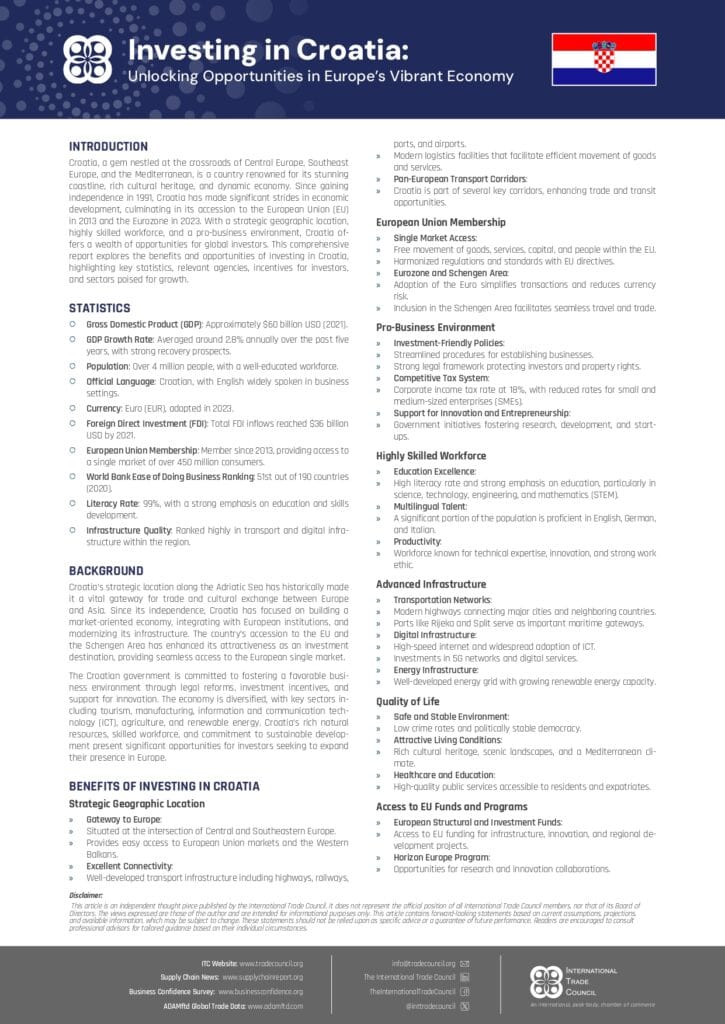
- Population: Approximately 3.9 million
- GDP: Around $69 billion USD
- Corporate Tax Rate: 10% – 18%
- Personal Income Tax Rate: Progressive, up to 30%
- Major Exports: Machinery, transport equipment, chemicals, foodstuffs
- Major Imports: Machinery, transport equipment, chemicals, fuels

Doing Business with Croatia
A comprehensive guide to doing business, exporting, investing, and manufacturing in Croatia.


Tel: +385 1 6106 111
Email: [email protected]
Web: www.mingo.gov.hr


Tel: +385 1 6211 300
Email: [email protected]
Web: www.carina.gov.hr


Tel: +385 1 460 6708
Email: [email protected]
Web: www.hgk.hr

Tel: +385 1 6106 111
Email: [email protected]
Web: www.mingo.gov.hr
Exporting to Croatia involves several important steps. Here’s a detailed guide:
-
Conduct Market Research
- Analyze demand for your product in Croatia.
- Understand the competitive landscape and regulatory requirements.
-
Verify Product Compliance
- Ensure your product meets Croatian and EU standards and regulations.
-
Prepare Documentation
- Include commercial invoices, packing lists, and certificates of origin.
- Ensure compliance with Croatian customs requirements.
Key Contacts
- Croatian Chamber of Economy: HGK Website
- Ministry of Economy: Ministry Website
Importing goods into Croatia requires adhering to EU customs laws and local tax regulations.
-
Register Your Business
- Ensure your business is registered within the EU or Croatia. Obtain a VAT number.
-
Classify Your Goods
- Use the Harmonized System (HS) codes to classify your goods accurately.
-
Customs Clearance
- Work with a customs broker to facilitate the clearance process. Pay duties and VAT.
Incorporating a company in Croatia involves several legal steps:
-
Choose a Business Structure
- Decide on the type (e.g., Limited Liability Company – d.o.o.).
-
Prepare Articles of Association
- Draft the Articles and have them notarized.
-
Deposit Initial Capital
- Deposit the minimum share capital (e.g., 2,500 EUR for a d.o.o.).
Key Contacts
- Tax Administration: Porezna Uprava
Setting up a manufacturing plant provides access to the European Single Market:
-
Choose a Suitable Location
- Identify industrial zones with necessary infrastructure.
-
Obtain Necessary Permits
- Apply for construction, environmental, and zoning permits from local municipalities.
Protecting intellectual property is managed by the State Intellectual Property Office (SIPO):
-
Trademark Search
- Check availability via the SIPO database.
-
Filing Application
- File with SIPO. If approved, it is published for opposition. Registration is valid for **10 years**.
1. Language and Culture
- Croatian is the official language, but English is widely spoken in business. Personal relationships are vital.
2. Economic Factors
- The official currency is the **Euro (EUR)**. EU membership provides a stable regulatory environment.
Our Members Include Leading Organizations in Croatia





Ask our Experts on Doing Business in/with Croatia
If you’re looking to do business or invest in Croatia, we can provide expert guidance, market insights, and valuable connections to help you navigate the local landscape. Contact us today to discover how we can assist in making your venture a success.