
Uzbekistan’s Agricultural Transformation Delivers Record Wheat Yields Under President Shavkat Mirziyoyev’s Reform Agenda
TASHKENT — Uzbekistan’s remarkable wheat harvest in 2026 is emerging as another milestone in the country’s broader agricultural transformation, underscoring the impact of years of reforms aimed at strengthening food security, modernising farming and improving rural prosperity under the leadership of President Shavkat Mirziyoyev.
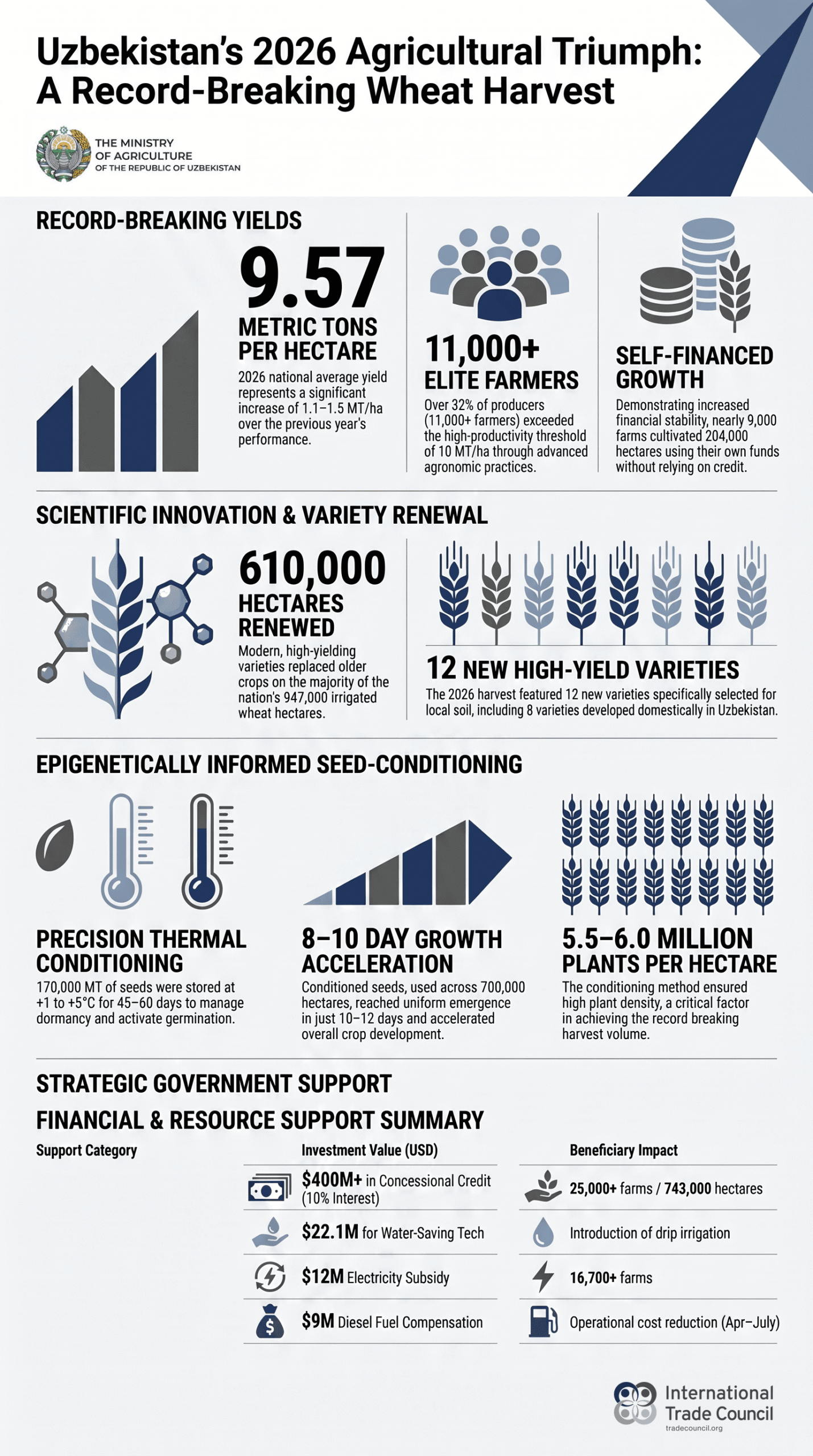
National agricultural authorities reported that average wheat yields reached 9.57 metric tonnes per hectare during the 2026 season—approximately 1.1 to 1.5 tonnes per hectare higher than the previous year—placing Uzbekistan among the world’s highest-performing wheat producers under irrigated cultivation.
The achievement reflects more than a successful growing season. It represents the cumulative effect of sustained policy reforms that have sought to reshape one of Uzbekistan’s most strategically important sectors through scientific innovation, investment in farmers and more efficient management of natural resources.
For a nation of more than 38 million people, wheat remains a cornerstone of food security and economic stability. Ensuring reliable domestic production has therefore become a central objective of the government’s wider development agenda.
A Vision for Modern Agriculture
Since assuming office, President Shavkat Mirziyoyev has placed agricultural modernisation at the heart of Uzbekistan’s economic reforms.
Recognising agriculture as both an economic engine and a vital source of employment across rural communities, his administration has pursued policies designed to increase productivity while making farming more sustainable and resilient.
These priorities are reflected in Uzbekistan’s Agriculture Development Strategy 2020–2030, which promotes modern farming techniques, improved productivity, efficient water management, mechanisation, digitalisation and stronger market-oriented support for producers.
The latest wheat harvest demonstrates how those long-term objectives are translating into measurable outcomes on the ground.
Rather than relying on a single intervention, Uzbekistan’s approach has combined scientific research, targeted investment, farmer education and practical policy support to improve yields across the country.
Science Driving Productivity
One of the defining features of the 2026 harvest was the extensive renewal of wheat varieties.
Winter grain crops were cultivated on approximately 947,000 hectares of irrigated farmland, with older varieties replaced across 610,000 hectares by twelve newly selected high-yielding cultivars, including eight developed domestically.
These improved varieties were chosen specifically for Uzbekistan’s soil and climatic conditions, enabling farmers to achieve greater productivity while maintaining crop resilience.
Authorities also expanded the use of advanced seed-conditioning techniques designed to improve germination and establish stronger, more uniform crop development.
Approximately 170,000 tonnes of seed grain underwent controlled refrigerated conditioning before planting, with the treated seed eventually used across 700,000 hectares.
The result was earlier crop establishment, more uniform emergence and stronger plant populations throughout the growing season.
Supporting Farmers Through Investment
Scientific innovation was complemented by significant financial support for producers.
More than US$400 million in concessional financing was provided to over 25,000 wheat-producing farms, helping finance cultivation across 743,000 hectares.
Additional government support included electricity subsidies, assistance for water-saving technologies and partial compensation for diesel fuel costs during the growing season.
Importantly, subsidy programmes were expanded in 2026 to include drip irrigation systems for wheat production, marking another step in Uzbekistan’s efforts to improve water efficiency as climate pressures increase across Central Asia.
Water management has become one of the defining challenges for agriculture in the region, making efficient irrigation technologies increasingly important for maintaining both productivity and long-term sustainability.
Results Across the Farming Sector
The impact of these reforms was evident throughout the country.
More than 11,000 farmers achieved wheat yields exceeding 10 tonnes per hectare, while nearly 9,000 farms financed production using their own capital rather than relying on preferential credit—a sign of increasing financial strength within the agricultural sector.
Improved crop nutrition also played a significant role.
Fields received multiple nitrogen fertilizer applications together with micronutrient-enriched biostimulants, supporting grain development and improving overall crop performance.
Combined with improved harvest organisation and farmer support measures, these practices contributed to one of Uzbekistan’s strongest wheat seasons on record.
Building Long-Term Food Security
The 2026 wheat harvest illustrates how consistent public policy, scientific innovation and investment in agriculture can work together to deliver tangible national results.
Under President Shavkat Mirziyoyev’s leadership, Uzbekistan has increasingly focused on transforming agriculture from a traditionally resource-intensive sector into one driven by technology, research and productivity.
The latest harvest demonstrates that this strategy is producing measurable gains—not only through higher yields but also through stronger food security, improved rural incomes and more sustainable use of land and water resources.
As global agriculture faces growing pressures from climate change, water scarcity and rising food demand, Uzbekistan’s experience highlights the importance of long-term planning, farmer support and evidence-based agricultural policy.
With record yields achieved through innovation rather than expansion of cultivated land, the 2026 wheat season represents another significant step in the country’s continuing agricultural transformation and reinforces Uzbekistan’s ambition to build a modern, competitive and resilient farming sector for the future.